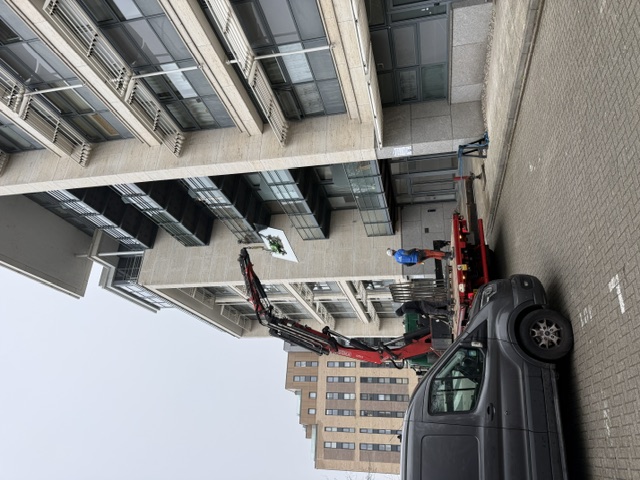
Smart switchable glass in Dartford turns a window or partition from clear to frosted at the touch of a switch, so you get privacy when you want it and the view when you do not. The glass contains a laminated PDLC interlayer driven by a small low-voltage transformer, and it can be wired to a wall switch, a phone app or a full building management system. We fit it in flats, period houses, offices and shopfronts across Dartford, where it replaces blinds, manages glare and keeps elevations tidy. Below we cover how it works, what it costs, how it fits with Part L and local planning, and how to pick a supplier.
Key insights
- Switchable glass gives instant privacy and glare control without blinds, and suits façades, internal partitions, roof lights and bathroom windows.
- The common technologies are PDLC (clear to frosted), SPD and electrochromic (clear to tinted), all laminated into a sealed unit and run on low-voltage controls that can talk to KNX, BACnet or IP systems.
- In Dartford, DA1 conservation areas the glass must match the sightlines, colour and reflectance of its neighbours in both states, so planners see no change to the street.
- Choose a supplier who can show Part L and fire compliance, local completed jobs, a written warranty on the interlayer and controls, and a maintenance plan.
Smart Switchable Glass in Dartford: What It Is
From the pavement, smart switchable glass looks like any other pane. The difference is inside the laminate: an active layer that changes from transparent to translucent, or from clear to tinted, when a small current is applied. The active layer is bonded between two sheets of glass during manufacture, then built into a sealed unit or used as a single laminated pane internally. That means it can sit within a period sash, a steel-framed Crittall window or a frameless office partition without disturbing the proportions a conservation officer cares about. Owners in Dartford use it to do away with blinds, control glare on screens and divide space without solid walls.
How Smart Switchable Glass Technology Works
Smart switchable glass is a filter you can switch. An active interlayer sits between the panes, and the microscopic structure inside it rearranges when a voltage is applied, which changes how light passes through, scatters or is absorbed. The glass itself never moves; only the way it handles light changes.
Three systems are in common use. PDLC holds liquid-crystal droplets in a polymer film: off, the droplets scatter light and the pane is frosted; on, they align and it clears. SPD uses suspended particles that line up under voltage to let light through, giving a clear-to-dark tint. Electrochromic glass moves ions through thin coatings and tints slowly in steps. In every case, thin busbars at the panel edge connect to a transformer in the frame or a nearby cupboard, and from there to a switch, a sensor or the building's control network. Because switching is electrical, daylight, glare and privacy become settings you can schedule rather than fixed properties.
Is Smart Switchable Glass Worth It in Dartford, DA1?
It tends to pay off when you treat it as a working part of the building rather than a luxury finish. Linked to a building management system, the glass can tint or frost automatically in response to sunlight, occupancy and cooling demand, which trims peak electricity use and can allow smaller air-conditioning plant. In a flat it does the job of blinds, curtains and solar film in one layer. On small Dartford sites, where every square metre and every degree of overheating counts, that usually makes the case.
Where Londoners Use Smart Glass: Homes, Offices and More
In compact flats, mews houses and riverside apartments it replaces blinds on bedroom and living-room glazing, balancing privacy, daylight and thermal performance in one clean surface. Offices use it for meeting rooms, quiet rooms and breakout areas that need to be screened at times but left open the rest of the day, so daylight still reaches the centre of the floor.
In refurbishments of listed and conservation-area buildings, smart glass goes in as switchable secondary glazing behind original sash or steel windows, so the façade is untouched and thermal performance improves without altering listed fabric. Hotels, galleries, dental practices and clinics then gain partitions that can switch between public and private without any change to the historic fabric.
Smart Switchable Glass Design, Controls and Integration
Specifying switchable glass in Dartford, DA1 involves three sets of decisions: appearance (panel sizes, frit, tint and framing), control (from a simple wall switch through to scheduled and sensor-driven automation) and how the glass connects with everything else in the building, including the BMS, lighting, blinds and access control.
Design Options And Aesthetics
Switchable glass works best when it is designed in from the start rather than hidden as a technical layer. In Dartford that means choosing interlayers, coatings and frame profiles that sit comfortably alongside brick, stone and timber.
- Façades: match panel sizes, frit patterns and tints so the elevation reads as one surface rather than a patchwork of different glass.
- Partitions: use full-height sheets in place of stud walls to keep rooms feeling larger and uncluttered.
- Roofs + skylights: grade the opacity across an atrium or roof light so daylight can be softened without blinds.
- Artistic installations: build switchable panels into feature walls or reception screens, where the change itself is the point.
Control Systems And Automation
A wall switch is the simplest option and still the right one for a bathroom. Beyond that, networked controllers add time schedules and rules based on orientation, occupancy and daylight, with zoning by room, remote updates and usage reports. Whatever the system, agree the protocols, the security measures and the fail-safe state in advance, so the glass drops to a known condition if power or the network fails.
Integration With Building Systems
Switchable glass in Dartford performs best when it is mapped into the building's BMS, lighting, shading and access-control layers rather than left as a stand-alone feature. Treat every glazed surface as a device with an address.
- Agree the interface protocol, typically BACnet, KNX, Modbus or IP, so the glass controllers fit your BMS schema.
- Build scenes that coordinate opacity, electric lighting and external blinds for comfort and energy balance.
- Connect occupancy, daylight and façade sensors so sensitive artefacts, fabrics and finishes are protected from sun.
- Tie the glass to access-control states so meeting rooms, galleries and lobbies move between public and private automatically.
Smart Switchable Glass: Energy Efficiency and Dartford Rules
Switchable glass should be assessed as an energy device, using the same figures as any other glazing: g-value in each state, U-value, visible light transmittance and peak-load reduction. Mapping those figures to Dartford, DA1 planning and energy policy, including the Dartford Plan, Approved Document L and council guidance, lets you present dynamic glazing as a compliance tool rather than an aesthetic extra.
Energy-Saving Performance Metrics
To prove that switchable glass improves a building's energy performance rather than just adding a high-tech façade, you need clear, comparable numbers:
- Cooling and heating load reduction: kWh saved per square metre of glazing, split by season.
- Dynamic solar heat gain coefficient (SHGC): the g-value curve for clear and tinted states, run against Dartford, DA1 weather data.
- Daylight autonomy and glare control: the share of occupied hours within comfortable light levels, with the switching response mapped.
- Peak demand impact: the cut in simultaneous cooling and lighting peaks, expressed as plant capacity avoided.
Meeting Dartford Planning Standards
Approval in Dartford depends on fitting the local planning framework: conservation area appraisals, protected views and the council's energy and sustainability guidance. In practice that means tabulating visible light transmission, reflectance and colour rendering for each state and checking them against townscape and daylight assessments, so the switch from clear to frosted does not affect strategic views or listed settings. Write the control logic into the energy strategy to show demand reduction under Dartford Plan policies, and set out maintenance, failure modes and manual overrides so officers trust the system to perform the same in ten years' time.
Smart Switchable Glass Costs, Maintenance and Lifespan
Cost, upkeep and realistic lifespan belong in a switchable glass specification alongside appearance and performance:
- Capital cost considerations: expect a clear premium over high-performance static glazing, plus the transformer, wiring and any BMS integration.
- Operational energy: PDLC draws power only while clear and the draw is small, but on a large façade it should be modelled against the solar-gain savings.
- Maintenance requirements: allow for periodic inspection of the control gear, replacement of drivers over time and a gentle cleaning routine.
- Lifespan and degradation: PDLC and SPD interlayers typically give ten to twenty years of service, with switching speed and contrast fading gradually rather than failing suddenly.
How to Choose a Smart Switchable Glass Supplier in Dartford
You want a firm that understands façade performance, control wiring and both period buildings and new-build flats. Ask for U-values, switching times, haze levels in the clear state and durability data backed by third-party testing. Check how they handle Part L, fire performance and any acoustic targets, ask for completed jobs in Dartford you can visit, and pin down warranties on the interlayer and control gear and how a damaged panel would be replaced.
See our main specialist glass page for the full range of options in Dartford. Related work we take on includes solar control glass and self-cleaning glass.
Frequently Asked Questions
Can Smart Switchable Glass Be Repaired After Accidental Impact or Scratching?
Sometimes, depending on where and how deep the damage is. A light scratch on the outer surface of a laminated panel can often be polished out without touching the active interlayer. A chip at the edge, a crack through the laminate or damage to the busbar usually means replacing the panel, because the conductive layer cannot be rejoined on site. We check circuit continuity, the laminate and the evenness of the frosted state before advising.
How Does Smart Glass Performance Change With Dartford’s Hard Water and Condensation?
Switching performance is unaffected, but hard water and condensation can mark the glass and stress the edges if ignored. We recommend an easy-clean coating on external faces and drainage detailing that moves water away from the edge seal. Condensation is handled with warm-edge spacers, a drained and ventilated frame rebate and, in bathrooms, adequate extraction. Keeping the interlayer edges dry preserves even switching and clarity in Dartford, DA1 homes.
Are There Privacy or Data-Security Concerns With App-Controlled Smart Glass Systems?
Treat an app-controlled glass system like any other connected device. Switching logs can reveal when rooms are occupied and when the property is empty, and a poorly secured controller could be switched by someone else. Ask for encrypted communication between app, hub and controller, strong authentication on any cloud account, the option to host locally, and user roles so a cleaner's login cannot change meeting-room schedules. Keep the firmware updated, as you would for a smart lock.
What Backup Options Exist if the Smart Glass Control System Fails?
Every installation we design has a manual fallback, at minimum a hard-wired wall switch beside the glass that works independently of any app or network. The panel should also rest in a known default state if power is lost: PDLC goes frosted when unpowered, which suits a bathroom but not a shopfront, so SPD or a different wiring approach may suit there. On larger systems we split the glazing into zones with separate circuits, so a fault affects one area only.
Can Existing Heritage or Listed Buildings in Dartford Use Internal Smart Glass Partitions?
Yes, provided the work is reversible and does not harm the original fabric. Internal switchable partitions are fitted as free-standing or lightly fixed secondary elements, kept clear of historic plaster, panelling and joinery, and designed to be removed later without trace. Listed Building Consent will normally be needed, so the application should show the fixing method, cable routes and a neutral interlayer that reads as a modern insertion.
Summary
Smart switchable glass in Dartford gives a bedroom, bathroom, meeting room or shopfront a window that is clear when you want the view and frosted when you want to be left alone. Specified with the right controls and installed with proper fallbacks, it cuts glare and cooling demand and keeps the façade free of blinds. Call us for a free survey and quote on switchable glass for your home or business.